
Can you help me distinguish between the different ice hockey shots? Like when a player would use each one and which ones are the hardest for netminders to stop
Can you help me distinguish between the different ice hockey shots? Like when a player would use each one and which ones are the hardest for netminders to stop.
2026 Winter Olympics Google Doodle is celebrates Ice Hockey 2026 on February 11. and it sparks a big question:
Different Ice Hockey Shots Explained: When to Use Each One and Which Are Hardest for Goalies to Stop
Ice hockey is one of the fastest sports in the world, and scoring a goal is about much more than just shooting hard. Players must choose the right type of shot at the right moment, balancing power, speed, accuracy, and deception.
While highlight reels often focus on booming slap shots, modern hockey shows that quick releases and unpredictable shots are often the most effective — especially against elite netminders.
In this guide, we’ll break down the main types of ice hockey shots, explain when players use each one, and reveal which shots goalies find hardest to stop.
Why Shot Selection Matters in Ice Hockey
Goalies today are bigger, faster, and more technically sound than ever. If a shooter gives them time to read the play, even the hardest shot can be stopped.
That’s why modern scorers focus on:
- Speed of release
- Deception
- Changing angles just before shooting
Now let’s look at the most common ice hockey shots and how they work.
1. Slap Shot – “The Clapper”
The slap shot uses a full wind-up, with the stick striking the ice just before the puck. This flexes the stick like a spring, transferring maximum energy into the shot.
Players Use When It Defensemen shooting from the blue line
- Power plays
- Situations with plenty of time and space
Goalie Perspective : Slap shots are the fastest shots in hockey, often exceeding 90–100 mph.
However, the long wind-up gives goalies time to square up and prepare, making them easier to read than many quicker shots.
2. Wrist Shot
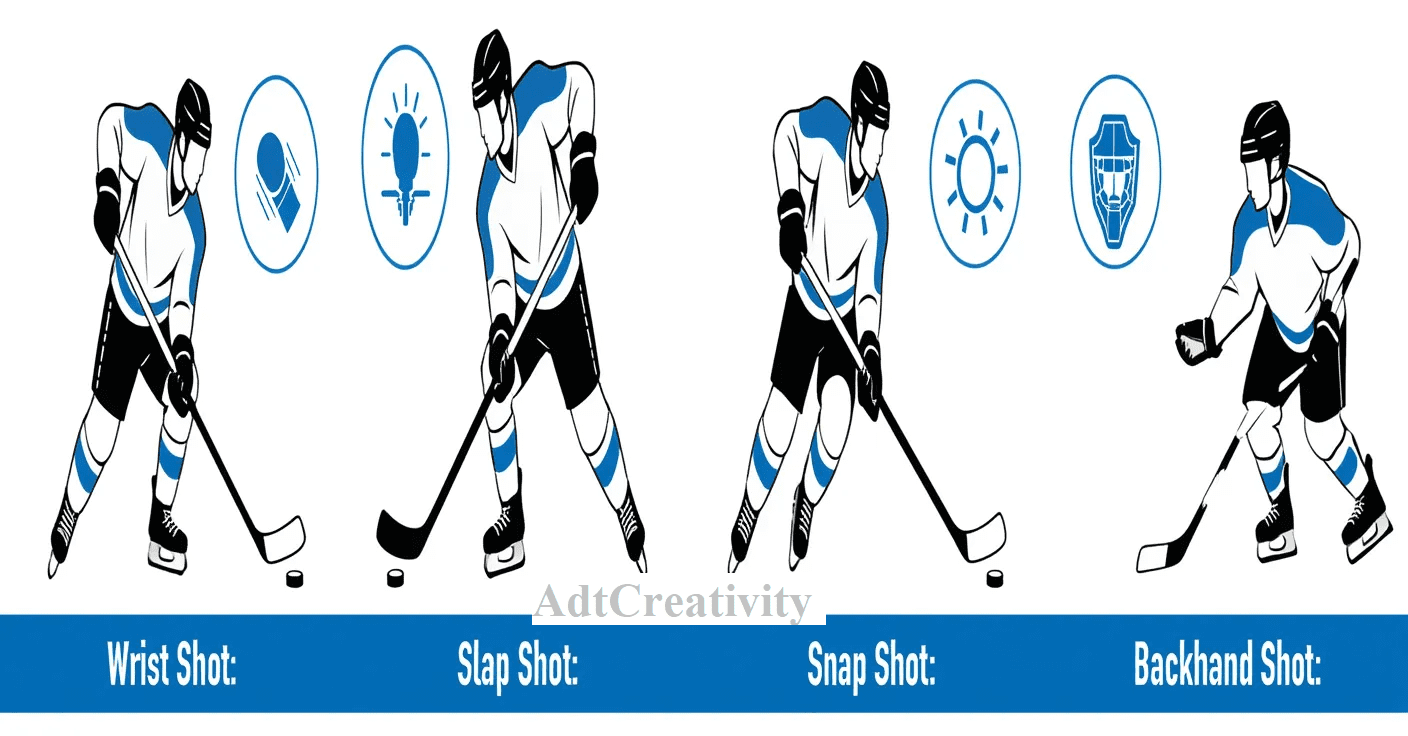
How It Works
The puck stays on the blade as the player rolls their wrists and snaps the shot forward with a smooth motion. player use it when While skating in stride.
Goalie Perspective
Wrist shots are dangerous because they lack a wind-up.
A low, quick wrist shot through traffic can be extremely hard to track, especially when released unexpectedly.
3. Snap Shot
The snap shot is a hybrid of the slap and wrist shot. It uses a short backswing and a rapid wrist snap to generate surprising speed.
Players Use It
- Off the rush
- In tight spaces
- When defenders are closing in
Goalie Perspective
Many goalies consider this the hardest shot to stop. It combines near-slap-shot velocity with the fastest release in hockey, leaving very little reaction time.
4. Backhand – Deception Over Power
The puck is shot using the back (convex) side of the stick blade. When Players Use It Breakaways,Rebounds near the crease
Backhands are extremely unpredictable.
Which Ice Hockey Shots Are Hardest to Stop?
While every goalie has personal strengths and weaknesses, certain situations consistently cause problems:
Quick Release Beats Power
A 70-mph snap shot with no warning is often harder to stop than a 100-mph slap shot the goalie sees coming.
Deceptive Backhands
Their unusual release and trajectory make them difficult to track.
Lateral Movement Before the Shot
Pulling the puck side-to-side forces the goalie to shift weight, often opening:
- The five-hole
- Low corners
The Most Dangerous Target Zone
Shots aimed 6–12 inches off the ice are especially tough — too high for pad saves and too low for easy glove reactions.
Scoring in ice hockey isn’t just about shooting harder — it’s about choosing the smartest shot at the perfect moment.
Modern players rely on quick releases, deception, and precise placement to beat even the best netminders in the world.
The next time you watch a goal, look beyond the speed and notice how and when the shot was released — that’s where the real skill lies.