

How Is It Possible for Ski Jumpers to Stay in the Air So Long And How They Train for It?
How Is It Possible for Ski Jumpers to Stay in the Air So Long And How They Train for It?
Ski jumping is one of the most thrilling and technically fascinating winter sports. At the 2026 Winter Olympics in Milano–Cortina, elite ski jumpers soared through the air, covering distances that seem to defy gravity — all while relying on precise physics, advanced training, and split-second body control.
In this blog, we’ll explore how ski jumpers stay aloft for 5–7 seconds, what techniques and training make that possible, and how this all ties into the excitement around ski jumping at the 2026 Games.
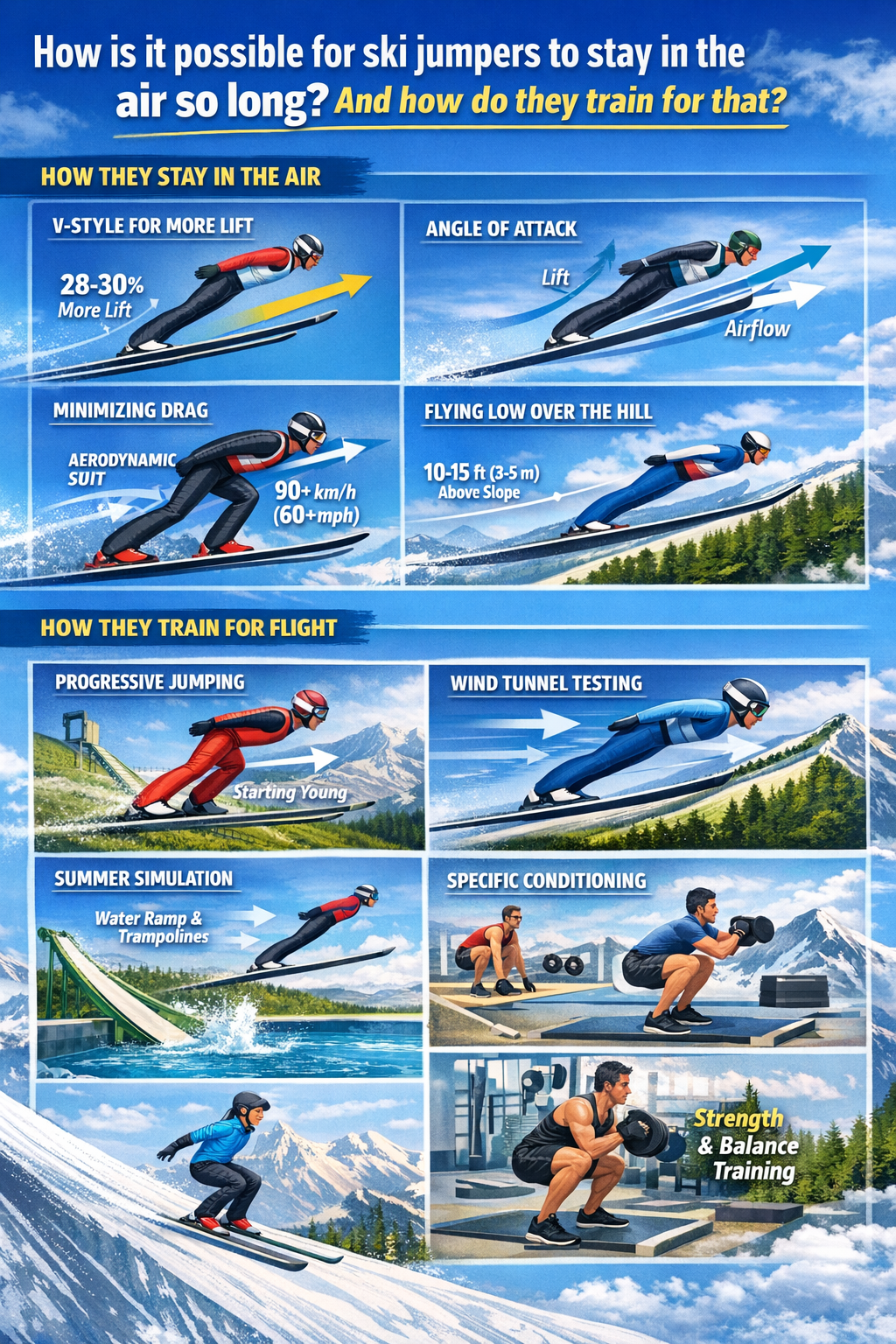
The Science: Flight, Not Jumping
At first glance, ski jumping might look like a dramatic leap of faith. But the truth is that elite jumpers don’t jump high so much as they fly far.
Unlike a normal vertical jump — which lasts less than a second and is dominated by gravity — ski jumping is about horizontal speed, aerodynamics, and lift. As athletes slide down the in-run and launch themselves off the takeoff ramp, they are already moving extremely fast (often 60+ mph).
Once airborne, jumpers transform their bodies and skis into a wing-like shape, manipulating airflow just as aircraft do without engines. The principles at play are:
• Gravity
Gravity pulls all objects downwards — whether a ball, a hang glider, or a ski jumper.
• Lift
Lift is the upward force created when air passes over and under a surface. Ski jumpers generate lift by angling their skis and bodies so that airflow pushes downward and lifts them upward.
• Drag
Drag is the resistance caused by air. Minimizing drag is essential because as drag slows the athlete, lift decreases too.
In simple terms, ski jumpers don’t cancel gravity — they slow their descent long enough to travel far forward. At the Olympics, top jumpers stay airborne for around 5–7 seconds, covering distances of 100 meters (328 feet) or more before landing safely.
Key Aerodynamic Techniques
The V-Style
One of the biggest advances in ski jumping was the adoption of the V-style. Instead of keeping skis parallel, jumpers spread their skis into a wide “V” shape in flight.
This increases surface area interacting with the air, creating more lift and stabilizing flight — a critical advantage over the older parallel style.
Optimal Angle of Attack
Jumpers position their bodies and skis at an angle that maximizes lift while minimizing drag. Too steep and the airflow breaks away (causing stalls), and too flat and not enough lift is produced.
Minimizing Drag
Aerodynamic suits, tight body position, and careful posture help reduce drag. Jumpers’ suits are strictly regulated so that loose fabric doesn’t create unintended lift or drag advantages.
Flying Close to the Slope
Instead of flying high into the sky, jumpers glide just a few meters above the hill’s surface — where the air is denser and more stable. This helps them maintain lift longer and cover more distance.
How Ski Jumpers Train
Staying airborne isn’t just physics — it’s the result of dedicated training developed over years.
Progressive Hill Training
Most elite ski jumpers begin training as children, mastering small hills before progressing to larger ones. This builds confidence, timing, and technique gradually.
Wind Tunnel Analysis
Top athletes use wind tunnel facilities to test body and ski positions precisely. Coaches measure lift, drag, and airflow patterns to refine the smallest adjustments for maximum performance.
Off-Season Practice
During summer months, jumpers train on special plastic-matted ramps and water landings. This allows them to simulate real jumps without snow. The in-run tracks are often slicked with water to mimic ice glide, giving realistic speed and airflow conditions.
Trampolines, bungee rigs, and balance training help athletes develop superior spatiotemporal perception — the ability to monitor and adjust their body position in mid-air.
Specific Conditioning
Training includes:
- Explosive leg strength for powerful takeoff
- Core stability to maintain rigid aerodynamic form
- Balance and control drills for mid-air adjustments
The result isn’t larger muscles — it’s controlled body efficiency optimized for flight.
Ski Jumping at the 2026 Winter Olympics
At the Milano–Cortina Winter Olympics 2026, ski jumping thrilled fans with elite-level competition. Events included normal and large hill jumps across men’s, women’s, and mixed team categories.
 2026 Winter Olympics Google Doodle is celebrates Ski Jumping 2026 on Feb 10. The Milano Cortina 2026 Olympic Games officially started from 6 to 22 February. On 10th February, Google is celebrating Ski Jumping events that are scheduled for the games at the Predazzo Ski Jumping Stadium in Predazzo, Italy. Google is celebrating the Winter Olympic Ski Jumping schedule event with an animated doodle that show the Ski jumper’s flight path through the air. This Google Doodle saying that moves fast, adapts to momentum, and turns motion into progress.
This is Sixth 2026 Winter Olympics Google Doodle after other Winter Olympic sports events like Curling 2026, Winter Sports 2026 Begin ,Ice Hockey, Snowboarding and Figure Skating.
6 Medals will be awarded in 6 events of Ski Jumping Normal hill, Large hill, for men, women and mixed team. A total of 100 Competitors from 22 nations are able to qualify to compete in the Ski Jumping events. Several countries, including Italy as Host , Norway, Austria, Germany, Japan, Canada, China, Poland , US, Great Britain are participating for this 6 Gold medals.
Ski Jumping at 2026 Winter Olympics Highlights: Norway’s Anna Odine Strøm won gold in the women’s normal hill individual event — a big early highlight of the Games. It was a slight upset over favorite Nika Prevc of Slovenia.
Slovenia’s Nika Prevc took silver, and Japan’s Nozomi Maruyama earned bronze, marking Japan’s first ski jumping medal at these Games.
Ski jumpers stay airborne not by defying physics, but by mastering it. Through precise aerodynamic form, careful body positioning, and year-round training, they turn forward speed into sustained flight. This combination of science and skill is at the heart of ski jumping — and what makes it one of the most spectacular events in the Winter Olympics