
Martin Luther King Jr. Biography: Life, Legacy, and the Dream That Changed America
Martin Luther King Jr. Biography: Life, Legacy, and the Dream That Changed America
Who was Martin Luther King Jr?
A Martin Luther King Jr. biography is more than a historical account—it is the story of how moral courage, nonviolent resistance, and faith reshaped a nation. Dr. Martin Luther King Jr. stands as one of the most influential leaders of the 20th century, not only in the United States but across the world. His voice helped dismantle legalized racial segregation, challenged injustice through peaceful protest, and inspired generations to believe that change is possible without hatred or violence.
Born into a deeply segregated America, King grew up witnessing racial inequality as a daily reality, not an abstract idea. Instead of accepting it, he questioned it—first as a child, then as a student, and ultimately as a leader of a mass movement. His life was marked by sacrifice, relentless activism, and unwavering commitment to justice, even when that commitment made him a target of intimidation, imprisonment, and violence.
This comprehensive biography of Martin Luther King Jr. explores his early life, education, rise as a civil rights leader, philosophy of nonviolence, major achievements, controversies, and lasting legacy. It draws on verified historical sources and aims to provide a clear, trustworthy, and human account of the man behind the movement.
Martin Luther King Jr. Early Life and Family Background
Birth and Martin Luther King Jr. Childhood
Martin Luther King Jr. was born on January 15, 1929, in Atlanta, Georgia, during the height of the Jim Crow era. He was originally named Michael King Jr., but his father later changed both their names to Martin Luther King after visiting Germany and learning about the Protestant reformer Martin Luther.
King grew up in a close-knit, middle-class African American family. His father, Martin Luther King Sr., was a respected Baptist minister and a prominent community leader. His mother, Alberta Williams King, was a former schoolteacher and church organist. Their home emphasized education, discipline, and religious faith—values that would deeply shape King’s worldview.
Early Encounters With Racism
As a child, King experienced racism firsthand. One of the most formative moments occurred when a white childhood friend was forbidden by his parents from playing with him due to his race. This incident left a lasting impression and planted early questions about fairness and justice.
Despite these experiences, King’s parents worked hard to instill self-worth and dignity in their children. His father, in particular, rejected submissive behavior toward segregation and taught his son to stand firm in the face of discrimination.
Martin Luther King Jr. Education and Intellectual Development
Academic Excellence at a Young Age
King was an exceptional student. He skipped both ninth and twelfth grades and entered Morehouse College in Atlanta at just 15 years old. Morehouse, a historically Black college, became a critical environment for King’s intellectual growth.
Initially, he was unsure about following in his father’s footsteps as a minister. However, exposure to influential mentors, including Dr. Benjamin E. Mays, president of Morehouse College, encouraged him to see the ministry as a platform for social change.
King graduated with a Bachelor of Arts in Sociology in 1948.
Theological Studies and Philosophy
After Morehouse, King attended Crozer Theological Seminary in Pennsylvania, where he excelled academically and was elected president of the student body. There, he studied the works of major philosophers and theologians, including:
- Henry David Thoreau
- Reinhold Niebuhr
- Mahatma Gandhi
It was during this period that King became deeply committed to nonviolent resistance, inspired particularly by Gandhi’s use of peaceful protest to confront injustice in India.
King later earned a Ph.D. in Systematic Theology from Boston University in 1955. His academic training sharpened his ability to combine moral reasoning, Christian theology, and social activism into a powerful, persuasive voice.
Martin Luther King Jr. Marriage and Personal Life
While studying in Boston, King met Coretta Scott, a talented musician and activist in her own right. The two married in 1953 and went on to have four children:
- Yolanda Denise King
- Martin Luther King III
- Dexter Scott King
- Bernice Albertine King
Coretta Scott King was not merely a supportive spouse; she was an active partner in the civil rights movement and later became a global advocate for peace and human rights after her husband’s death.
Rise of a Civil Rights Leader Martin Luther King Jr.
Montgomery Bus Boycott (1955–1956)
The turning point in Martin Luther King Jr.’s life came in 1955, shortly after he became pastor of Dexter Avenue Baptist Church in Montgomery, Alabama.
When Rosa Parks was arrested for refusing to give up her bus seat to a white passenger, the Black community organized a boycott of the city’s bus system. King, only 26 years old, was chosen to lead the newly formed Montgomery Improvement Association.
The boycott lasted 381 days, during which King’s home was bombed and he was repeatedly threatened. Despite the pressure, he urged protesters to remain nonviolent. In 1956, the U.S. Supreme Court ruled that bus segregation was unconstitutional—a landmark victory.
This event launched King into national prominence.
Southern Christian Leadership Conference (SCLC)
In 1957, King co-founded the Southern Christian Leadership Conference (SCLC). The organization aimed to coordinate nonviolent protests across the South and empower Black churches to lead the struggle for civil rights.
Under King’s leadership, the SCLC became one of the most influential civil rights organizations in American history, focusing on:
- Ending segregation
- Protecting voting rights
- Challenging economic inequality
Martin Luther King Jr. Philosophy of Nonviolence
Moral and Strategic Foundations
A defining feature of Martin Luther King Jr.’s biography is his unwavering commitment to nonviolent resistance. For King, nonviolence was not passive. It was a disciplined, courageous method of confronting injustice without dehumanizing opponents.
He believed that violence would only deepen racial divisions and undermine moral authority. Instead, nonviolence aimed to:
- Expose injustice
- Awaken public conscience
- Create lasting reconciliation
King often emphasized that nonviolence was not about avoiding conflict, but about transforming it.
Major Civil Rights Campaigns of Martin Luther King Jr.
Birmingham Campaign (1963)
The Birmingham Campaign targeted one of the most segregated cities in America. Protesters faced police dogs, fire hoses, and mass arrests. King himself was jailed, where he wrote the now-famous “Letter from Birmingham Jail.”
In the letter, he defended civil disobedience and criticized white moderates who urged patience instead of justice. The text is widely regarded as one of the most important documents of the civil rights movement.
March on Washington (1963)
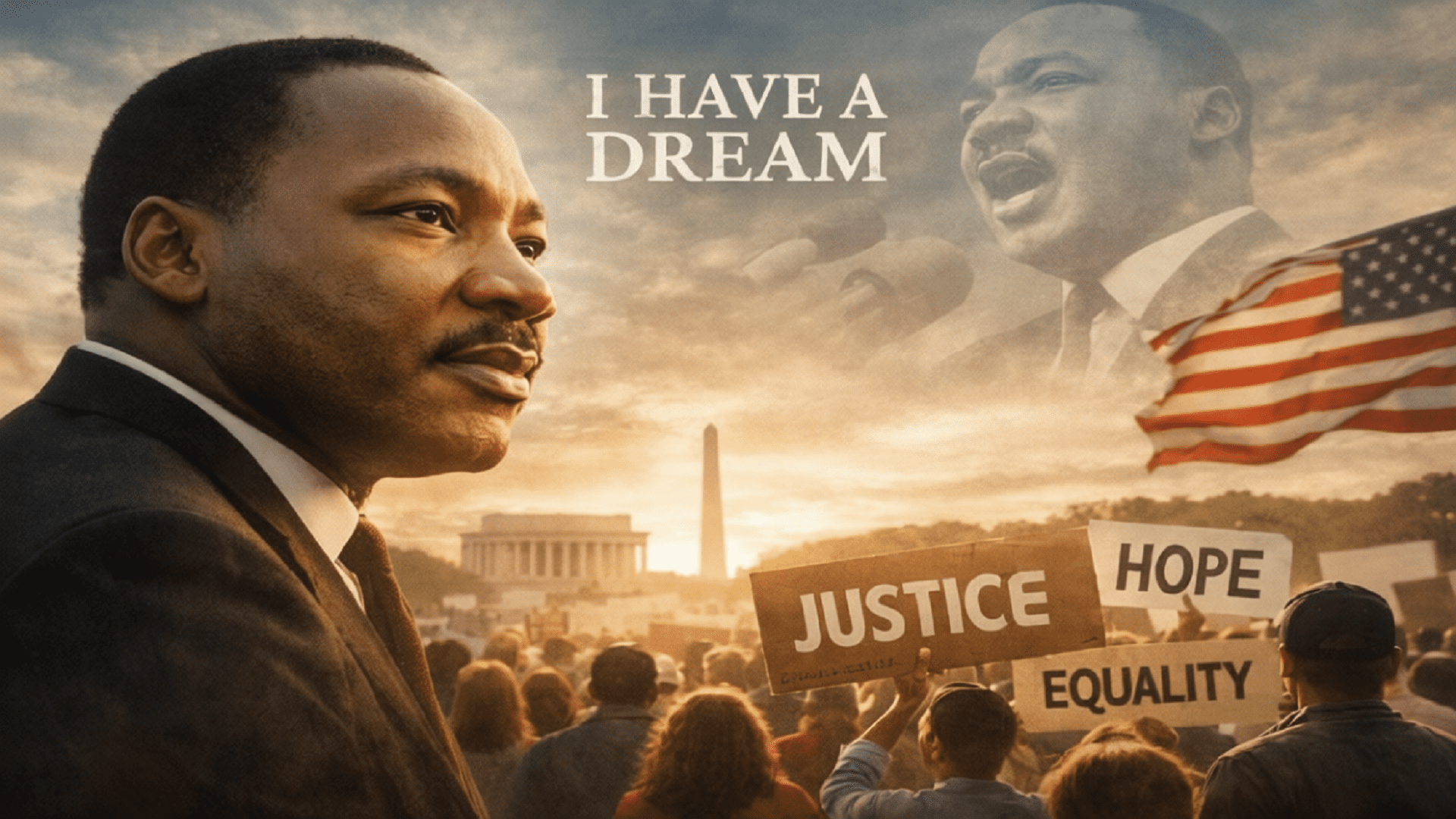
On August 28, 1963, King delivered his iconic “I Have a Dream” speech during the March on Washington for Jobs and Freedom. Speaking before over 250,000 people at the Lincoln Memorial, he articulated a vision of racial equality rooted in American ideals.
The speech remains one of the most quoted and studied orations in history.
Legislative Impact of Martin Luther King Jr.
King’s activism played a crucial role in the passage of two landmark laws:
- Civil Rights Act of 1964 – outlawed segregation and discrimination based on race, color, religion, sex, or national origin
- Voting Rights Act of 1965 – prohibited racial discrimination in voting
These laws reshaped American democracy and marked major victories for the civil rights movement.
Martin Luther King Jr. Nobel Peace Prize
In 1964, Martin Luther King Jr. became the youngest recipient of the Nobel Peace Prize at the time. He was awarded the honor for his leadership in nonviolent resistance to racial injustice.
King donated the prize money to support the civil rights movement, reinforcing his commitment to collective progress over personal gain.
Later Years and Expanding Focus
Economic Justice and Anti-War Activism
In his later years, King broadened his focus to include economic inequality and opposition to the Vietnam War. He argued that racism, poverty, and militarism were interconnected evils.
This stance made him increasingly controversial, even among former allies. Nevertheless, he remained steadfast in his belief that justice required addressing all forms of systemic injustice.
Poor People’s Campaign
King launched the Poor People’s Campaign to demand economic rights for all Americans, regardless of race. The campaign emphasized fair wages, housing, and access to education.
Assassination and Martin Luther King Jr. Death
On April 4, 1968, Martin Luther King Jr. was assassinated in Memphis, Tennessee, while supporting striking sanitation workers. His death sent shockwaves across the world and sparked widespread mourning and unrest.
James Earl Ray later pleaded guilty to the assassination, though questions and debates surrounding the case persist to this day.
Legacy and Global Influence
National Recognition
In 1983, the United States established Martin Luther King Jr. Day as a federal holiday, observed annually on the third Monday of January. It honors his life, values, and contributions to civil rights.
Lasting Impact
King’s influence extends far beyond American borders. His philosophy has inspired movements for justice and democracy worldwide, including efforts against apartheid, authoritarianism, and social inequality.
His writings, speeches, and leadership continue to shape conversations about race, equality, and moral responsibility.
Key Facts About Martin Luther King Jr.
- Full Name: Martin Luther King Jr.
- Born: January 15, 1929
- Died: April 4, 1968
- Occupation: Baptist minister, civil rights leader
- Known for: Nonviolent civil rights activism
- Famous Speech: “I Have a Dream”
A well-researched Martin Luther King Jr. biography reveals a man of deep conviction, intellectual rigor, and extraordinary moral courage. He was not a flawless hero, but a disciplined leader who chose hope over fear and justice over comfort.
King’s message remains urgent today: injustice anywhere is a threat to justice everywhere. His life reminds us that progress is neither automatic nor easy—but it is possible when ordinary people commit to extraordinary principles.
Frequently Asked Questions (FAQs) About Martin Luther King Jr.
1. Who was Martin Luther King Jr.?
Martin Luther King Jr. was an American Baptist minister and civil rights leader who played a central role in ending racial segregation and advancing equal rights through nonviolent protest.
2. When was Martin Luther King Jr. born?
Martin Luther King Jr. was born on January 15, 1929, in Atlanta, Georgia.
3. Where was Martin Luther King Jr. born?
He was born in Atlanta, Georgia, United States.
4. What is Martin Luther King Jr. best known for?
He is best known for leading the U.S. civil rights movement, advocating nonviolence, and delivering the iconic “I Have a Dream” speech.
5. What was Martin Luther King Jr.’s role in the civil rights movement?
King served as a leader, strategist, and spokesperson, organizing peaceful protests and campaigns against racial segregation and discrimination.
6. What did Martin Luther King Jr. believe in?
He believed in nonviolent resistance, equality, social justice, and the moral responsibility to oppose unjust laws.
7. Why did Martin Luther King Jr. support nonviolence?
He believed nonviolence was the most effective way to confront injustice without perpetuating hatred or division.
8. What is the “I Have a Dream” speech about?
The speech outlines King’s vision of a future where people are judged by character rather than skin color and enjoy equal rights and freedom.
9. When did Martin Luther King Jr. give the “I Have a Dream” speech?
He delivered the speech on August 28, 1963, during the March on Washington.
10. What organizations did Martin Luther King Jr. lead?
He co-founded and led the Southern Christian Leadership Conference (SCLC).
11. What was the Montgomery Bus Boycott?
It was a 381-day protest against bus segregation in Montgomery, Alabama, sparked by Rosa Parks’ arrest and led by King.
12. How did Martin Luther King Jr. influence U.S. laws?
His activism helped lead to the passage of the Civil Rights Act of 1964 and the Voting Rights Act of 1965.
13. Did Martin Luther King Jr. go to college?
Yes, he attended Morehouse College, Crozer Theological Seminary, and earned a Ph.D. from Boston University.
14. What degrees did Martin Luther King Jr. earn?
He earned a bachelor’s degree in sociology, a divinity degree, and a doctorate in systematic theology.
15. Who was Martin Luther King Jr.’s wife?
His wife was Coretta Scott King, an activist and advocate for civil rights and peace.
16. How many children did Martin Luther King Jr. have?
He had four children: Yolanda, Martin Luther King III, Dexter, and Bernice.
17. What awards did Martin Luther King Jr. receive?
He received numerous honors, including the Nobel Peace Prize in 1964.
18. Why was Martin Luther King Jr. awarded the Nobel Peace Prize?
He was awarded the prize for his leadership in nonviolent resistance to racial injustice.
19. What was the “Letter from Birmingham Jail”?
It was a powerful essay written by King defending civil disobedience and criticizing racial injustice and complacency.
20. What was the Poor People’s Campaign?
It was a movement launched by King to address economic inequality and poverty affecting Americans of all races.
21. Why did Martin Luther King Jr. oppose the Vietnam War?
He believed the war diverted resources from social programs and contradicted moral and humanitarian values.
22. How did Martin Luther King Jr. die?
He was assassinated on April 4, 1968, in Memphis, Tennessee.
23. Where was Martin Luther King Jr. assassinated?
He was assassinated at the Lorraine Motel in Memphis.
24. Who assassinated Martin Luther King Jr.?
James Earl Ray pleaded guilty to the assassination, though the case remains debated.
25. How old was Martin Luther King Jr. when he died?
He was 39 years old at the time of his death.
26. Why is Martin Luther King Jr. Day celebrated?
The holiday honors his contributions to civil rights, equality, and justice.
27. When is Martin Luther King Jr. Day observed?
It is observed on the third Monday of January each year in the United States.
28. What is Martin Luther King Jr.’s legacy?
His legacy includes major civil rights reforms, global influence on nonviolent movements, and continued inspiration for social justice.
29. How did Martin Luther King Jr. change the world?
He helped dismantle institutional racism in the U.S. and inspired peaceful movements for equality worldwide.
30. Why is Martin Luther King Jr. still relevant today?
His teachings on justice, equality, and nonviolence remain vital in addressing modern social and racial challenges.