
Show a Herbig-Haro and how they are photographed
Show a Herbig-Haro and how they are photographed
What’s a Herbig-Haro and How Are They Photographed?
NASA’s James Webb Telescope Reveals the Secrets of Newborn Stars
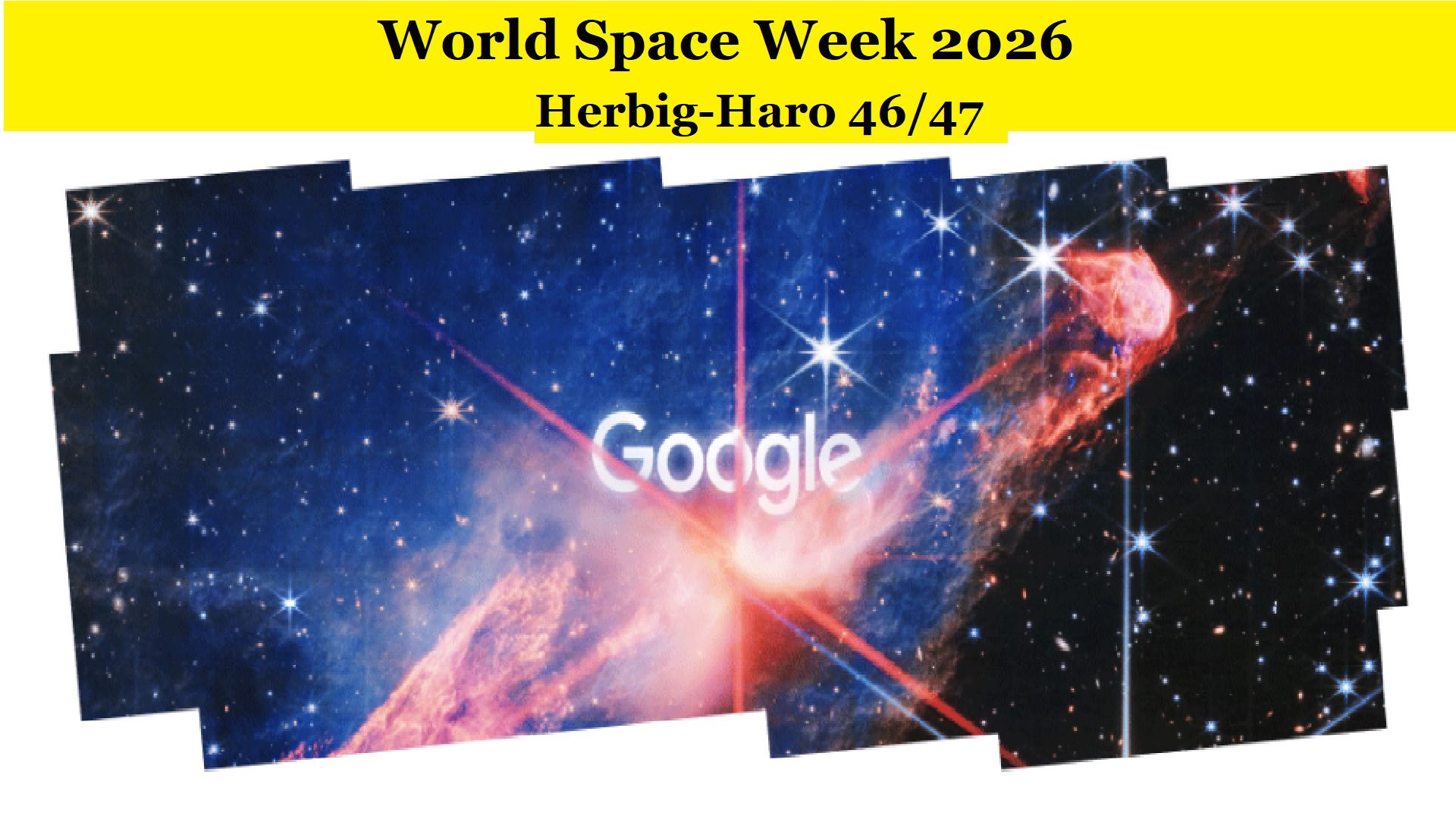
World Space Week 2026 Google Doodle: Have you ever wondered how astronomers photograph newborn stars hidden behind enormous clouds of cosmic dust? The answer involves powerful space telescopes, infrared cameras, specialized filters, and advanced imaging techniques.
As part of World Space Week 2026, celebrated from October 4 to October 10, Google’s October 9 Doodle highlights Herbig-Haro 46/47, a fascinating region of star formation observed by NASA’s James Webb Space Telescope (JWST).
Herbig-Haro objects offer astronomers a remarkable opportunity to study how stars are born and how their powerful jets interact with surrounding clouds of gas and dust.
But what exactly is a Herbig-Haro object, and how are Herbig-Haro objects photographed? Let’s explore the science behind these extraordinary cosmic structures.
What Is a Herbig-Haro Object?
A Herbig-Haro (HH) object is a small, glowing region of gas produced when high-speed jets from a young, developing star collide with surrounding interstellar material.
These objects form during the early stages of star formation, when newborn stars are still surrounded by dense clouds of gas and dust.
As material falls toward a developing star, some of it is redirected outward through powerful, narrow jets.
These jets can travel at hundreds of kilometers per second.
When they strike surrounding gas and dust, they produce shock waves that heat and excite the gas, causing it to glow.
The resulting luminous structures are known as Herbig-Haro objects.
They are relatively short-lived on astronomical timescales, typically evolving over thousands to tens of thousands of years.
Herbig-Haro objects are named after astronomers George Herbig and Guillermo Haro, who independently studied these unusual glowing regions during the mid-20th century.
What Is Herbig-Haro 46/47?
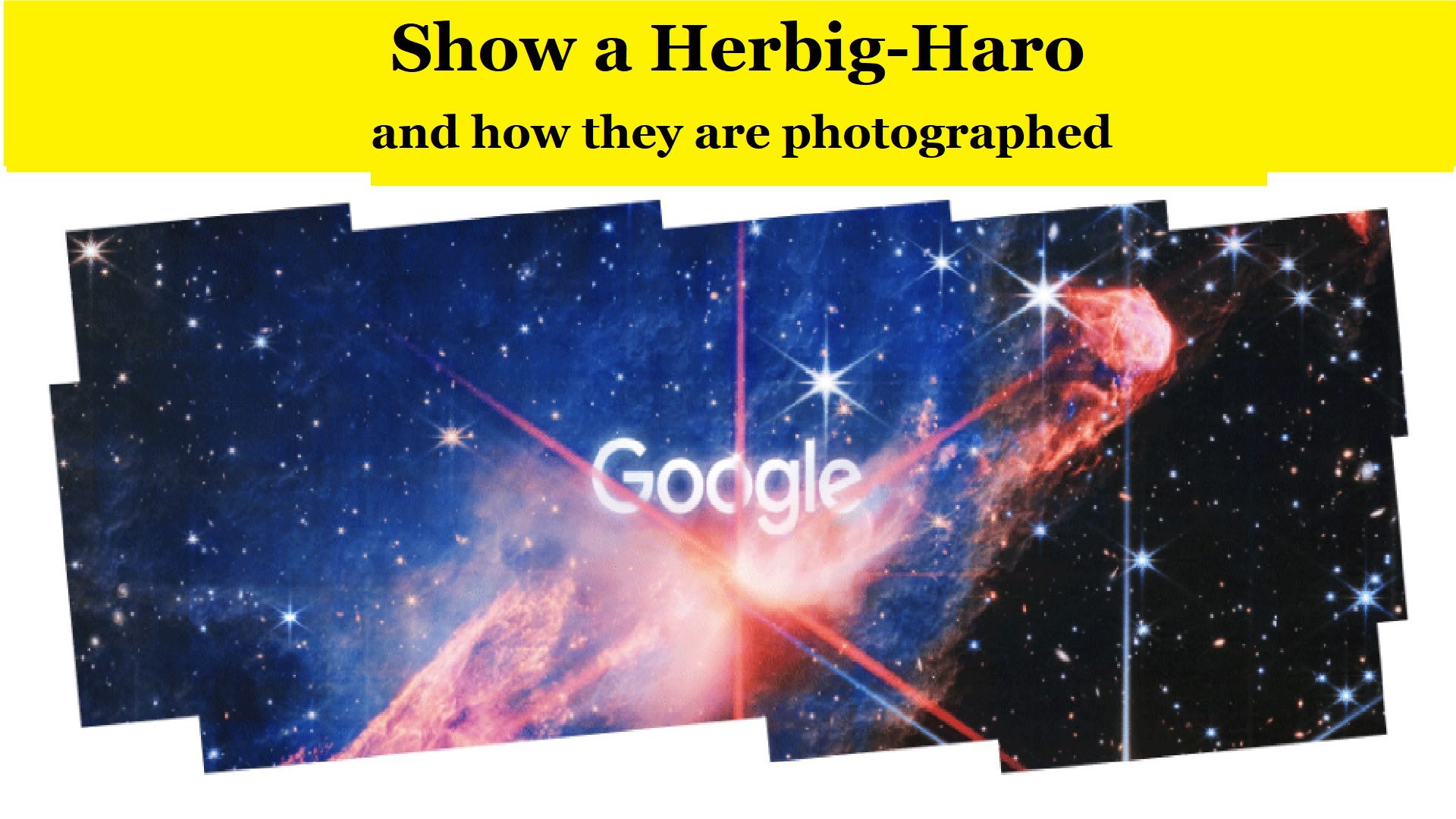
Herbig-Haro 46/47 (HH 46/47) is a remarkable stellar outflow system located approximately 1,470 light-years from Earth in the constellation Vela.
It contains a young star surrounded by gas and dust, with powerful jets extending into the surrounding interstellar environment.
NASA’s James Webb Space Telescope has captured a spectacular near-infrared image of HH 46/47, revealing structures that are difficult to observe in ordinary visible light.
The image shows energetic outflows emerging from a young stellar system, surrounded by a vast region of glowing gas and cosmic dust.
Webb’s observations help astronomers investigate how young stars launch jets, interact with their surroundings, and influence nearby star-forming material.
How Are Herbig-Haro Objects Photographed?
Photographing Herbig-Haro objects is challenging because the stars responsible for their formation are often deeply embedded inside thick clouds of cosmic dust.
These clouds absorb and scatter visible light, making it difficult for ordinary optical telescopes to observe the developing stars directly.
To capture these distant cosmic structures, astronomers rely on several specialized imaging techniques.
1. Infrared Imaging: Seeing Through Cosmic Dust
Infrared imaging is one of the most important techniques used to study Herbig-Haro objects.
Unlike visible light, certain infrared wavelengths can travel through dusty regions more effectively, allowing astronomers to observe structures hidden inside stellar nurseries.
NASA’s James Webb Space Telescope is especially powerful for this type of observation.
It carries advanced instruments including:
– NIRCam (Near-Infrared Camera): Captures detailed near-infrared images of stars, galaxies, and star-forming regions.
– MIRI (Mid-Infrared Instrument): Observes longer infrared wavelengths, helping scientists study cooler dust and molecular material.
The Hubble Space Telescope also supports infrared observations using its near-infrared imaging capabilities.
For Herbig-Haro 46/47, Webb’s NIRCam observations reveal intricate details of the young star’s outflows and surrounding clouds.
Infrared observations are particularly valuable because they help astronomers study regions that would otherwise remain obscured by cosmic dust.
2. Narrowband Filtering: Isolating Glowing Gas
Another important technique is narrowband filtering.
Herbig-Haro objects emit light at specific wavelengths associated with excited and ionized gas.
Astronomers use specialized filters to isolate these wavelengths while suppressing unwanted background light.
Common narrowband filters include:
Hydrogen-alpha (H-α): Detects light emitted by hydrogen at approximately 656.3 nanometers. This emission appears deep red in visible light and is useful for studying ionized gas.
Sulfur II (SII): Captures emission from singly ionized sulfur, often associated with shock-excited regions.
Oxygen III (OIII): Detects emission from doubly ionized oxygen, helping reveal particular regions of energized gas.
By observing through these filters, astronomers can separate different emission features and investigate the physical conditions within stellar jets.
The resulting images are often assigned colors and combined into detailed astronomical photographs.
These colors help scientists distinguish different structures and emission processes.
3. Long Exposures and Large-Aperture Telescopes
Herbig-Haro objects can be extremely faint and compact, making them difficult to photograph from Earth.
Professional observatories overcome this challenge by using large telescopes capable of collecting substantial amounts of light.
One example of powerful ground-based astronomical imaging equipment is the Dark Energy Camera (DECam), installed on the Blanco 4-meter Telescope at Cerro Tololo Inter-American Observatory in Chile.
DECam has approximately 570 megapixels and was designed to capture detailed, wide-field astronomical images.
Although DECam is not specifically dedicated to Herbig-Haro observations, it illustrates the advanced imaging technology available to modern astronomers.
Long-exposure photography allows telescopes to collect more photons from faint objects.
Astronomers often capture multiple exposures and combine them to improve the signal-to-noise ratio.
This process can reveal faint jets, shock fronts, and other details that might otherwise remain invisible.
4. Image Stacking and Digital Processing
Capturing astronomical images is only the beginning.
Scientists also use advanced computer processing to transform raw telescope observations into detailed scientific images.
The process generally involves:
1. Capturing multiple exposures: Recording the target repeatedly to gather more light.
2. Calibrating the images: Correcting sensor noise, instrumental effects, and other imperfections.
3. Aligning the frames: Ensuring stars and other features occupy consistent positions.
4. Stacking the images: Combining exposures to improve image quality and reveal faint structures.
5. Color processing: Assigning or combining colors to represent different wavelengths or emission features.
These techniques help astronomers reveal details that would be difficult to detect in individual exposures.
Importantly, many astronomical images use representative colors to display information collected at wavelengths that human eyes cannot directly see.
Can Amateur Astronomers Photograph Herbig-Haro Objects?
Yes. Experienced amateur astrophotographers can capture certain Herbig-Haro objects using suitable equipment and observing conditions.
However, many HH objects are faint, small, and difficult targets.
A typical backyard astrophotography setup may include:
– Astronomical telescope: A refractor or reflector with suitable focal length and light-gathering capability.
– Monochrome astronomy camera: A sensitive camera, often cooled to reduce electronic noise.
– Narrowband filters: Filters such as H-α, SII, and OIII to capture selected emission wavelengths.
– Tracking mount: Equipment that compensates for Earth’s rotation during long exposures.
– Computer and imaging software: Used for telescope control, calibration, stacking, and image processing.
Amateur astronomers may collect exposures over several nights to improve image quality.
Targets such as HH 1/2 and HH 46/47 can be particularly challenging, depending on telescope capabilities and observing conditions.
Although backyard equipment cannot match the resolution and infrared sensitivity of the James Webb Space Telescope, skilled astrophotographers can still record fascinating details of star-forming regions.
Why Are Herbig-Haro Objects Important to Astronomy?
Herbig-Haro objects are more than beautiful cosmic photographs.
They provide valuable scientific evidence about the earliest stages of stellar evolution.
Understanding Star Formation
By studying Herbig-Haro objects, astronomers learn how young stars accumulate material and launch powerful jets during their formation.
Investigating Magnetic Fields
Magnetic fields play an important role in directing and shaping stellar outflows. Observations of jets help scientists test models of these processes.
Studying Stellar Nurseries
Powerful jets transfer energy and momentum into surrounding clouds of gas and dust.
These interactions can influence the structure and evolution of star-forming regions.
Understanding the Origins of Planetary Systems
Studying the environments around newborn stars helps astronomers understand the conditions in which planetary systems may eventually develop.
World Space Week 2026 and the Herbig-Haro 46/47 Google Doodle
World Space Week is an international celebration of space science and technology, observed annually from October 4 to October 10.
The official theme for World Space Week 2026 is “Rocket Revolution,” emphasizing innovations in rocket technology and their role in transforming access to space.
Google’s October 9, 2026, Doodle celebrates Herbig-Haro 46/47 through imagery associated with NASA’s James Webb Space Telescope.
The Doodle brings attention to the remarkable scientific discoveries made possible by modern space observatories.
Other space-themed Doodles during the week have highlighted spectacular astronomical regions, including the Rosebud Nebula and Carina Nebula.
Together, these images offer a glimpse into the beauty and complexity of the universe.
Frequently Asked Questions (FAQs)
What is a Herbig-Haro object in simple terms?
A Herbig-Haro object is a glowing cloud of gas created when powerful jets from a newborn star collide with surrounding material, producing bright shock waves.
How are Herbig-Haro objects photographed?
Astronomers photograph Herbig-Haro objects using infrared telescopes, narrowband filters, long exposures, large-aperture telescopes, and advanced image-processing techniques.
Which telescope photographed Herbig-Haro 46/47?
NASA’s James Webb Space Telescope captured detailed near-infrared observations of Herbig-Haro 46/47 using its NIRCam instrument.
How far away is Herbig-Haro 46/47?
Herbig-Haro 46/47 is located approximately 1,470 light-years from Earth in the constellation Vela.
Why is infrared imaging important for Herbig-Haro objects?
Infrared imaging allows astronomers to observe certain structures through cosmic dust more effectively than visible-light imaging, revealing young stars and their surrounding outflows.
Can amateur astronomers photograph Herbig-Haro objects?
Yes. Some Herbig-Haro objects can be photographed by experienced amateur astrophotographers using suitable telescopes, sensitive cameras, narrowband filters, and long exposures.
What is the theme of World Space Week 2026?
The official theme of World Space Week 2026 is Rocket Revolution, highlighting advances in rocket technology and expanded opportunities for space exploration.
Why are Herbig-Haro objects important?
They help astronomers understand star formation, stellar jets, magnetic fields, and the interaction between newborn stars and surrounding clouds of gas and dust.
Herbig-Haro objects are among the most fascinating signs of stellar birth in our universe.
These glowing structures form when powerful jets from young stars collide with surrounding material, producing spectacular shock waves.
Thanks to modern astronomical technology, particularly NASA’s James Webb Space Telescope, scientists can now observe many of these structures in extraordinary detail.
From infrared imaging and narrowband filtering to long exposures and digital image processing, specialized photography techniques are helping astronomers uncover the secrets of star formation.
As World Space Week 2026 celebrates humanity’s achievements in space science and technology, Herbig-Haro 46/47 reminds us that the universe is constantly evolving—and every new observation brings us closer to understanding how stars, planets, and cosmic systems are born.