
I’m debating with my friends whether the T20 stop clock is actually good for the game. When did it become official and what are the exact penalties? Is there data around how it’s helped and have any teams been penalized for it?
I’m debating with my friends whether the T20 stop clock is actually good for the game. When did it become official and what are the exact penalties? Is there data around how it’s helped and have any teams been penalized for it?
Is the T20 Stop Clock Good for the Game? Rules, Penalties, Data & Real-World Impact
I’m debating with my friends whether the T20 stop clock is actually good for the game. When did it become official and what are the exact penalties? Is there data around how it’s helped and have any teams been penalized for it?
If you’ve found yourself arguing with friends about whether the T20 stop clock is a smart innovation or an unnecessary intrusion, you’re not alone. Since its introduction, the rule has sparked debate among fans, commentators, and former players alike.
Some see it as a long-overdue fix for over-rate delays. Others worry it adds artificial pressure to a format already defined by urgency.
So let’s step back and examine this properly:
-
When did the T20 stop clock become official?
-
What are the exact penalties?
-
Has it actually improved the game?
-
And have teams really been punished under it?
This guide breaks it down clearly, using verified information from the International Cricket Council (ICC) and real tournament examples.
When Did the T20 Stop Clock Become Official?
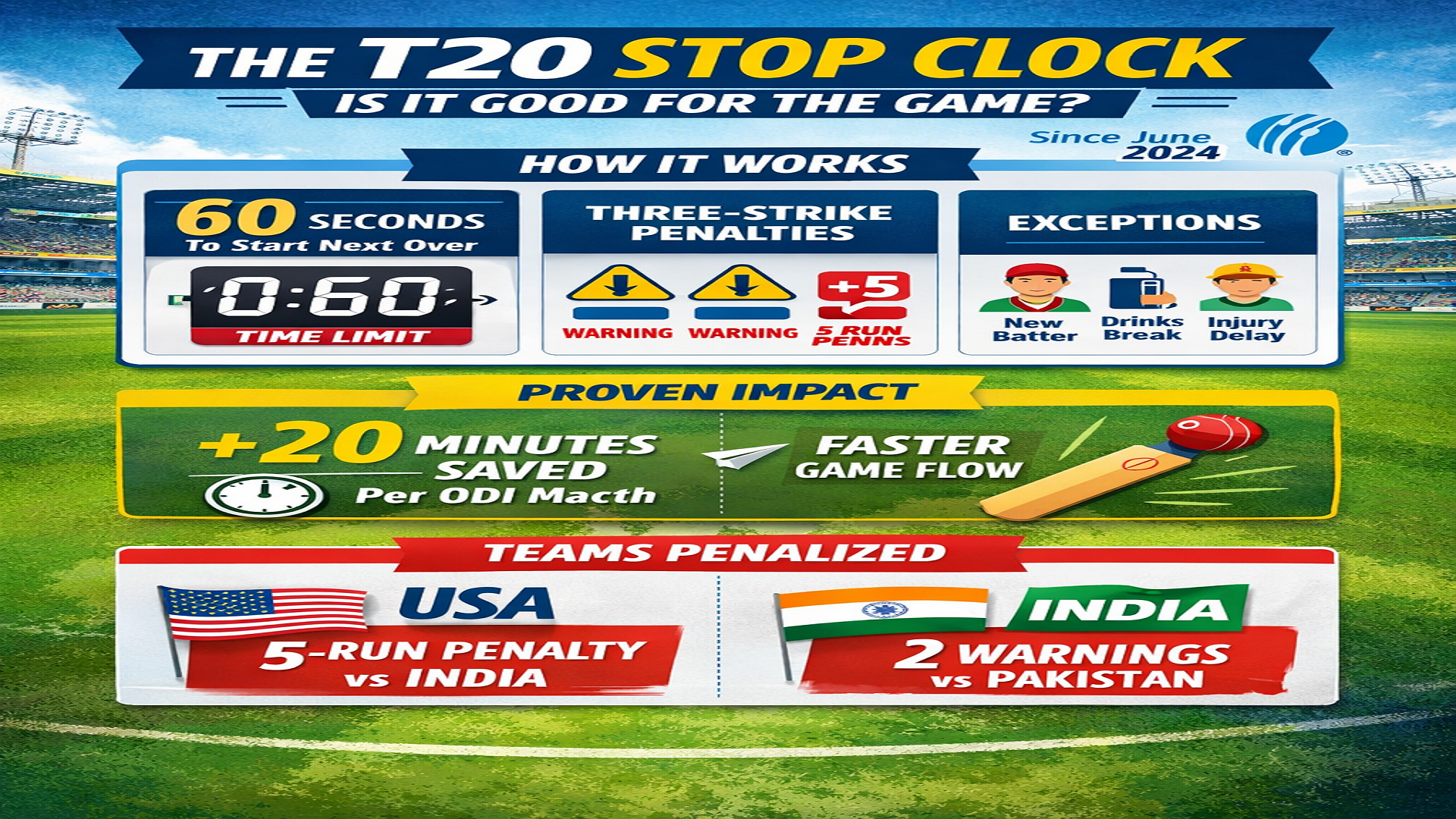
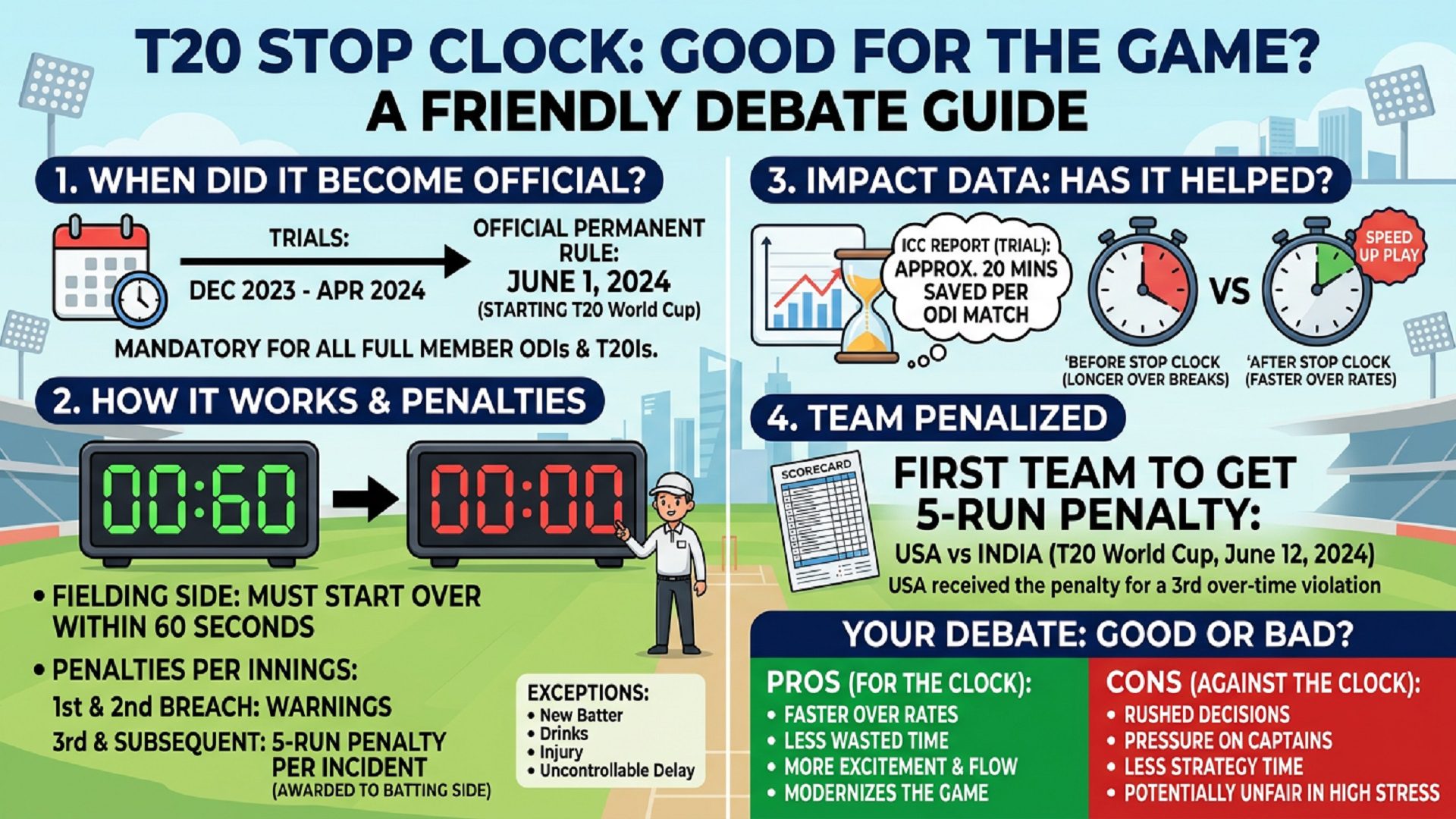
The stop clock was first introduced as a trial by the ICC from December 2023 to April 2024 in international white-ball matches.
After reviewing the data, the ICC made the rule permanent from June 1, 2024. It now applies to:
-
All ICC Men’s T20 Internationals (T20Is)
-
All ICC Men’s One Day Internationals (ODIs)
Its first major tournament implementation came at the 2024 Men’s T20 World Cup.
The ICC’s stated objective was simple: improve over rates and reduce unnecessary delays between overs.
Over-rate issues have frustrated broadcasters, fans, and administrators for years. T20 cricket, in particular, is built on pace and entertainment. Matches running significantly overtime contradict the format’s design.
The stop clock was introduced to enforce tempo in real time — not after the match through fines.
What Is the T20 Stop Clock Rule?
At its core, the rule is straightforward.
The 60-Second Requirement
The fielding side must be ready to bowl the first ball of the next over within 60 seconds of the previous over ending.
An electronic countdown clock appears in the stadium. The third umpire determines when the timer begins.
Unlike traditional over-rate penalties, this rule operates ball-to-ball, over-to-over.
There is no ambiguity. Either the fielding side is ready within 60 seconds — or it isn’t.
The Three-Strike Penalty System Explained
The ICC adopted a graduated system rather than an immediate punishment.
First Violation
The umpire issues a formal warning to the fielding captain.
Second Violation
A second official warning is given.
Third Violation
A five-run penalty is awarded to the batting team.
The strikes reset at the end of the innings. This ensures that one poor phase doesn’t permanently doom a side for the rest of the match.
The five-run penalty is added immediately to the batting team’s score.
In T20 cricket, five runs can be decisive. That’s why this rule carries real weight.
Who Controls the Stop Clock?
The enforcement process is structured and transparent:
-
The third umpire controls when the clock starts.
-
A visible stadium countdown ensures public accountability.
-
On-field umpires issue warnings and confirm penalties.
Because the clock is visible, teams cannot claim confusion about timing. Everyone — players, officials, fans — can see the same countdown.
Are There Exceptions?
Yes. The ICC built flexibility into the rule.
The stop clock may be paused or cancelled in situations such as:
-
A new batter arriving at the crease
-
Official drinks intervals
-
On-field injury treatment
-
Delays outside the fielding team’s control
This prevents unfair punishment for circumstances beyond a captain’s influence.
The rule targets avoidable delays — not genuine disruptions.
Why Was the Rule Introduced?
Over-rate enforcement has long been a challenge in international cricket.
Previously, penalties often included:
-
Match fees fines
-
Captain suspensions
-
Fielding restrictions in limited-overs cricket
However, those punishments usually came after the match. They did little to improve the real-time spectator experience.
The stop clock shifts accountability into the present moment.
Instead of retrospective punishment, teams must maintain discipline every over.
Has the Stop Clock Actually Helped?
According to trial data presented to the ICC’s Chief Executives’ Committee, the rule saved approximately 20 minutes per ODI match during the experimental phase.
That reduction played a significant role in the ICC’s decision to make the rule permanent.
Shorter match durations benefit:
-
Broadcasters with fixed programming windows
-
Stadium staff and logistics teams
-
Players managing workload
-
Fans attending weekday matches
In T20 cricket, where total match time is expected to stay within roughly three hours, reducing dead space between overs aligns with the format’s commercial and entertainment goals.
While public ball-by-ball datasets isolating T20 time savings are limited, the ICC’s official adoption confirms the trial delivered measurable improvements.
Have Teams Been Penalized?
Yes. And it happened on a global stage.
USA – First Five-Run Penalty
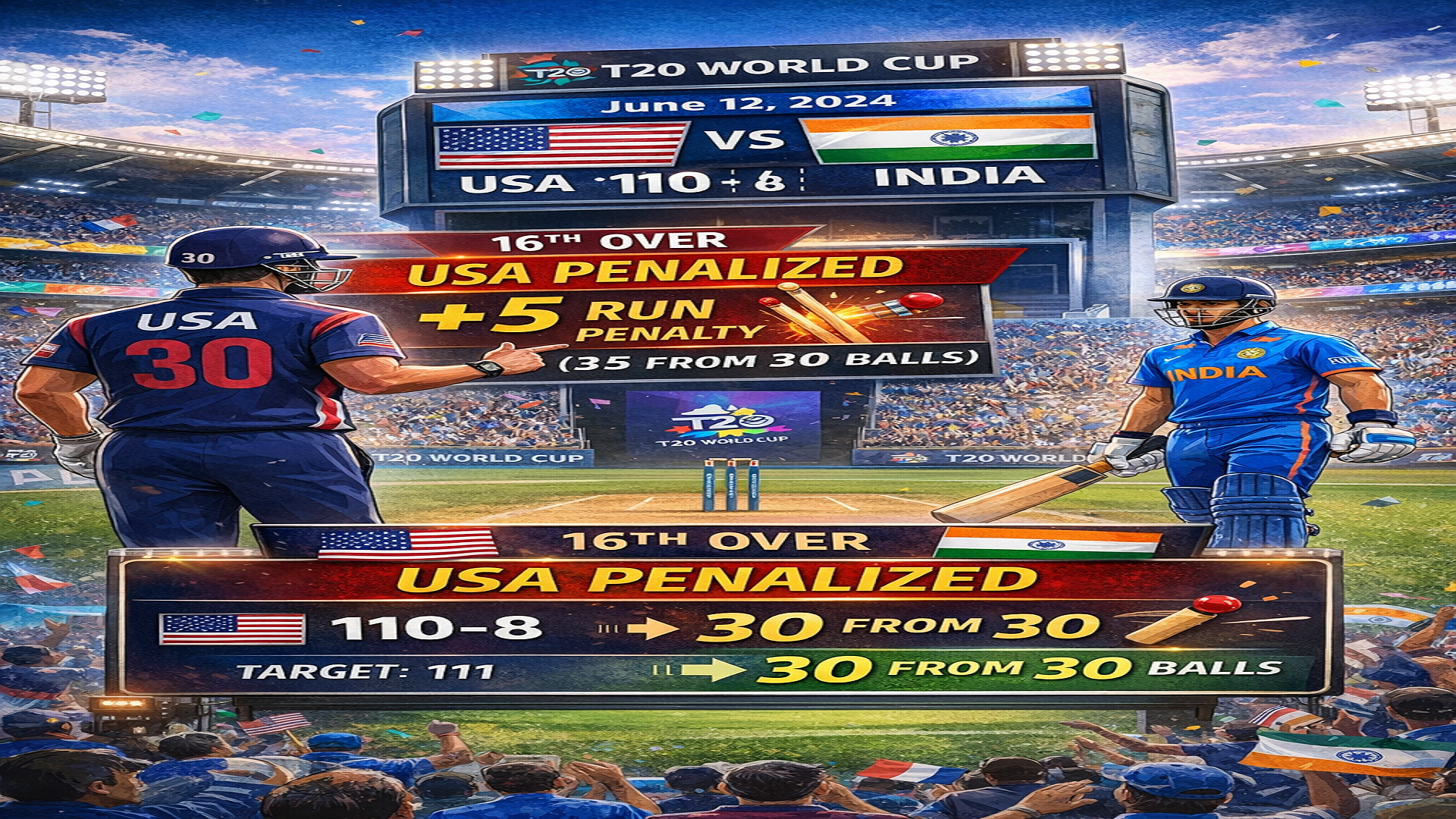
The United States national cricket team became the first team to receive a five-run penalty under the stop clock rule during their match against the India national cricket team at the 2024 Men’s T20 World Cup on June 12, 2024. On June 12, the USA was penalised at the start of the 16th over. This means that India’s run chase was reduced to needing 30 runs off 30 deliveries to reach their 111-run target instead of 35 off 30 balls.
After exceeding the 60-second limit for the third time in the innings, the umpire awarded India five penalty runs.
The moment drew significant media attention because:
-
It occurred in a World Cup match
-
It directly impacted the match equation
-
It demonstrated the ICC would enforce the rule strictly
It was no longer theoretical. The stop clock had tangible consequences.
India vs Pakistan – A Near Miss
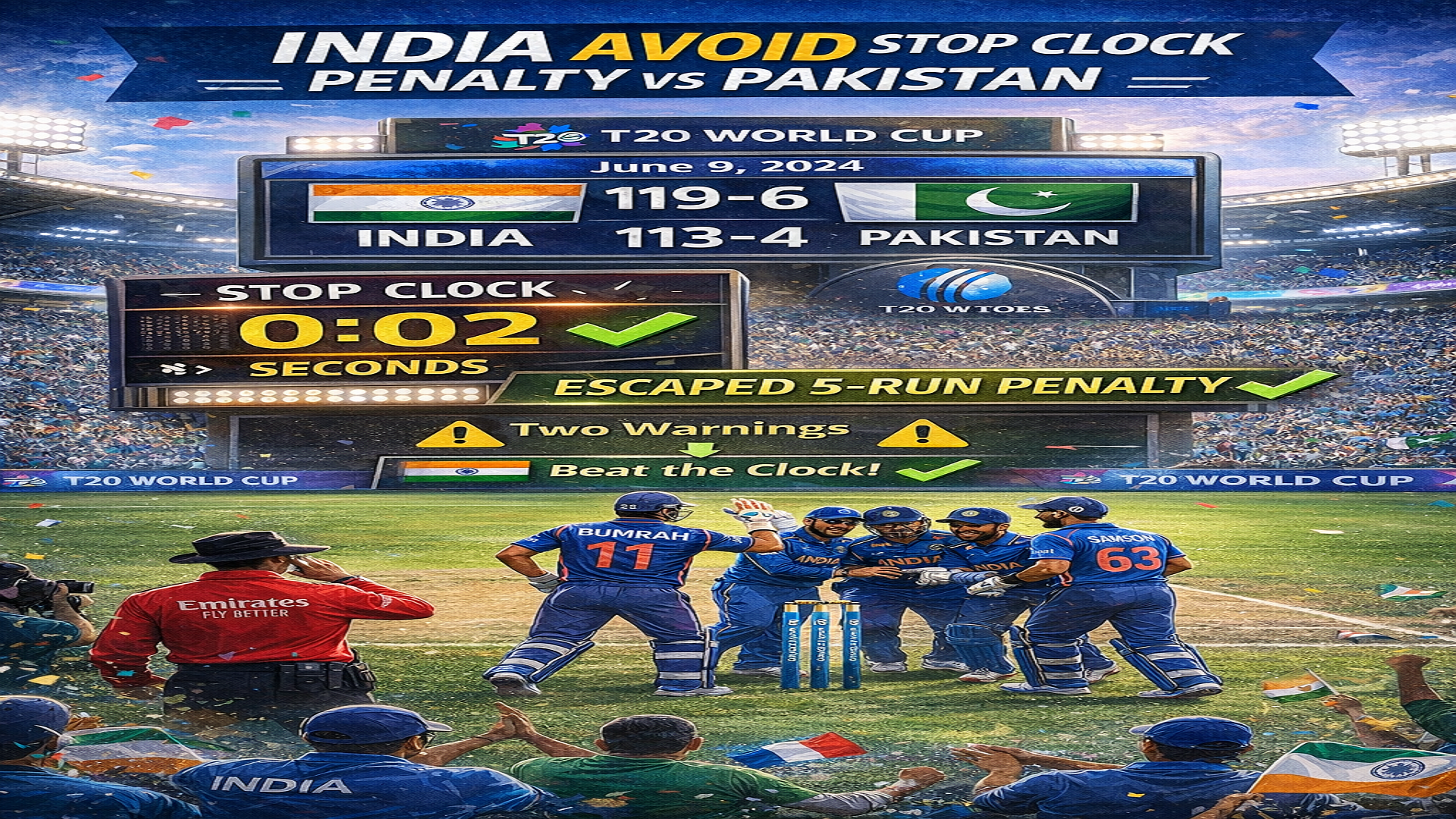
How India Avoided Stop Clock Penalty vs Pakistan | T20 World Cup 2024 In a high-profile clash between India and the Pakistan national cricket team during the same tournament, India received two stop clock warnings.
However, they avoided a third violation and escaped the five-run penalty.
The incident highlighted how quickly teams can approach the danger zone in high-pressure matches.
Does the Stop Clock Change Captaincy Strategy?
Absolutely.
Captains now:
-
Pre-plan field changes more carefully
-
Reduce extended tactical discussions
-
Rotate bowlers efficiently
-
Move fielders into position immediately
Teams have adapted by becoming more organized between overs. Support staff often help signal field adjustments faster.
The rule subtly encourages proactive planning rather than reactive scrambling.
Arguments in Favor of the Stop Clock
Supporters of the rule point to several benefits:
1. Faster Game Flow
Long gaps between overs break momentum. The stop clock restores rhythm.
2. Accountability
Teams must manage time efficiently. The rule eliminates casual delays.
3. Better Broadcast Product
Television scheduling improves when matches stay within predictable windows.
4. Alignment With T20 Identity
T20 cricket markets itself as fast and dynamic. A strict tempo supports that brand.
Many administrators argue that in an era competing with multiple entertainment platforms, maintaining pace is essential.
Arguments Against the Stop Clock
Critics raise legitimate concerns.
1. Harshness of the Five-Run Penalty
Five runs in T20 cricket can swing tight contests. Some argue the punishment outweighs the offense.
2. Pressure on Captains
Captains already juggle tactics, matchups, and field settings. The clock adds another layer of stress.
3. Reduced Tactical Breathing Room
Complex field changes, especially late in an innings, sometimes require discussion.
Former players have suggested that while improving over rates is important, in-game run penalties feel severe compared to traditional fines.
Has It Changed Match Outcomes?
So far, there is no evidence that the stop clock has dramatically altered tournament standings.
However, it has:
-
Created pressure moments
-
Influenced match narratives
-
Increased discipline expectations
The USA penalty demonstrated that the rule can impact live match situations.
Even when it doesn’t directly decide outcomes, the psychological pressure is real.
Is the Stop Clock Good for the Game?
The answer depends on perspective.
From an administrative and commercial standpoint, the rule appears effective. Verified ICC trial data showed meaningful time savings, leading to permanent adoption.
From a competitive standpoint, it introduces an additional strategic element. Teams must manage time with the same precision as field placements.
From a purist’s viewpoint, opinions remain divided.
Cricket has evolved repeatedly — from powerplays to DRS to super overs. Each change faced resistance before becoming normalized.
The stop clock may follow a similar path.
T20 stop clock A Necessary Modern Adjustment?
The T20 stop clock became a permanent regulation on June 1, 2024, after a successful trial period. It enforces a 60-second over transition rule with a clear three-strike system and a five-run penalty for repeated violations.
It has already:
-
Saved measurable match time during trials
-
Produced high-profile warnings
-
Delivered at least one confirmed five-run penalty
-
Forced teams to sharpen match management
Whether you love it or dislike it, one fact is clear: the rule reflects modern cricket’s push toward efficiency and entertainment value.
If your debate centers on fairness versus flow, here’s the balanced takeaway:
The stop clock improves tempo and accountability. But in tight T20 contests, five runs can feel enormous.
Cricket continues to evolve. And like most innovations in the sport’s history, this one may feel controversial now — yet routine in a few seasons.