
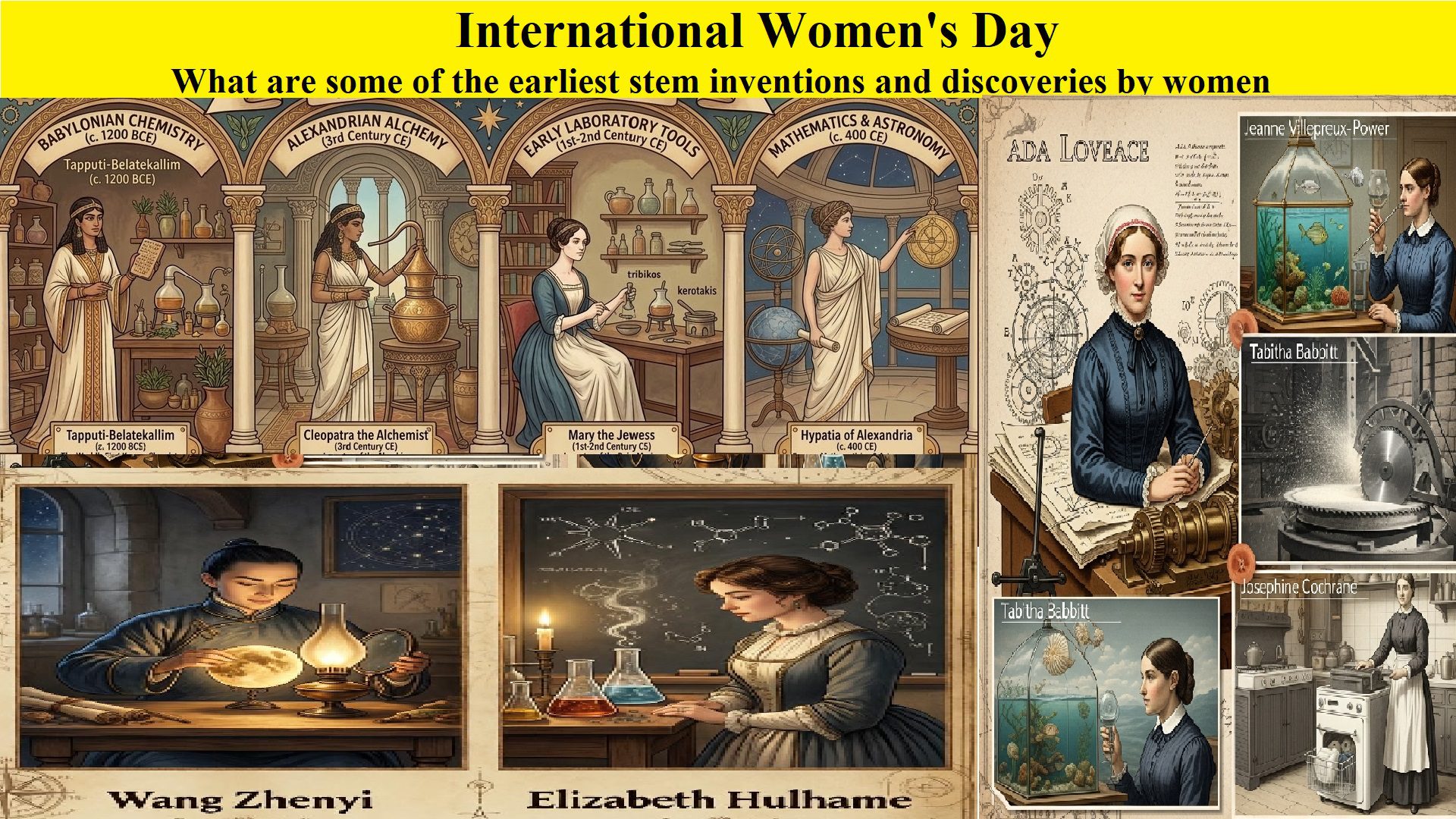
What are some of the earliest stem inventions and discoveries by women
What Are Some of the Earliest STEM Inventions and Discoveries by Women?
What are some of the earliest stem inventions and discoveries by women : On 8 March, International Women’s Day, the annual celebration recognizes the achievements of women across every field of life. In 2026, the International Women’s Day Google Doodle highlighted women’s contributions to Science, Technology, Engineering, and Mathematics (STEM), reminding viewers that many of the foundations of modern science were built by women — often without recognition.
After seeing this tribute, a question comes to mind:
What are some of the earliest STEM inventions and discoveries by women?
Women were making scientific breakthroughs thousands of years ago, long before modern laboratories existed. From ancient chemistry to early computing, their work shaped the world we live in today.
Ancient Inventions & Discoveries by Women (Pre-500 CE)
Tapputi-Belatekallim – The First Known Chemist (c. 1200 BCE)
One of the earliest recorded scientists in history is Tapputi-Belatekallim, a Babylonian perfumer mentioned on Mesopotamian cuneiform tablets. She developed one of the first known chemical processes using: distillation, filtration, extraction, purification. Her recipes for perfumes used flowers, oils, and resins combined through controlled heating and cooling. These methods resemble modern laboratory chemistry techniques. Historians often describe her as the world’s first recorded chemist.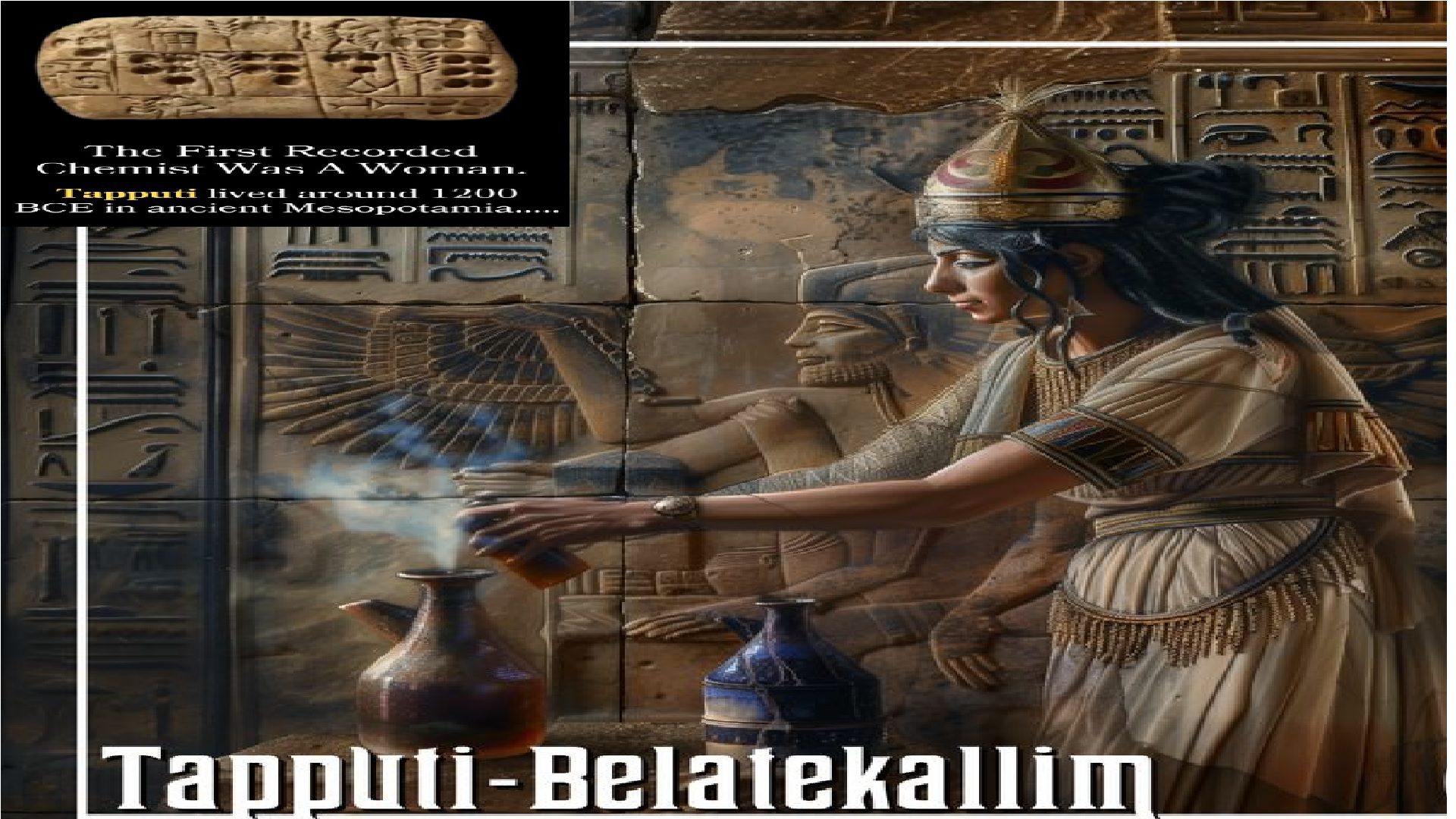
Cleopatra the Alchemist – Early Distillation Technology (3rd century CE)
Not to be confused with the Egyptian queen, Cleopatra the Alchemist was a Greek alchemist who lived in Roman Egypt. She is credited with inventing the alembic, one of the earliest devices used to distill liquids. This tool later became essential for: medicine, chemistry, perfume making, alcohol distillation
The alembic remained in use for centuries and influenced modern laboratory glassware.
Mary the Jewess – Laboratory Tools Still Used Today (1st–2nd century CE)
Another early pioneer of chemistry was Mary the Jewess, also known as Maria Hebraea. She invented several laboratory devices, including: Bain-marie (double boiler) .
Tribikos (three-armed distillation device)
Kerotakis (sealed heating apparatus)
The bain-marie is still used today in chemistry labs, cooking, pharmaceutical production. Her work shows that experimental science existed long before modern universities.
Hypatia of Alexandria – Mathematics & Astronomy (c. 400 CE)
Hypatia was one of the first famous female mathematicians and astronomers, working in Alexandria, Egypt. She is known for improving the astrolabe, teaching advanced mathematics and developing instruments such as the hydrometer. These tools helped scientists measure stars, liquids, and angles more accurately. Hypatia’s work influenced Greek, Roman, and later Islamic science traditions.
Pandrosion – Early Work on Cube Roots (4th century CE)
The Greek mathematician Pandrosion worked on complex geometry problems, including early methods for calculating cube roots, a difficult mathematical problem studied for centuries.
Although only fragments of her work survive, later mathematicians referenced her methods, showing her influence on classical mathematics.
Women’s Discoveries in Natural Science & Mathematics (11th–18th Century)
After the fall of the Roman Empire, scientific records became rarer, but women still contributed to medicine, astronomy, and chemistry.
Trota of Salerno – Early Medical Science (11th century)
Trota of Salerno was a physician from the famous medical school of Salerno in Italy. She wrote one of the earliest medical texts focused on women’s health, often grouped under Trotula manuscripts. Her work discussed childbirth, gynecology, medical treatments, hygiene. These writings influenced European medicine for hundreds of years.
Wang Zhenyi – Explaining Lunar Eclipses (18th century)
Chinese scientist Wang Zhenyi made important contributions to astronomy and mathematics in the 1700s. She explained lunar eclipses using a simple experiment with a lamp (Sun), a mirror (Moon), a table (Earth). Her demonstration showed that eclipses occur when Earth blocks sunlight — a clear scientific explanation at a time when many people believed eclipses were supernatural.
She also wrote about mathematics, geography, and physics.
Elizabeth Fulhame – The Concept of Catalysis (1794)
Scottish chemist Elizabeth Fulhame introduced the idea that a substance could help a chemical reaction occur without being consumed. This idea became known as catalysis, a fundamental concept in modern chemistry. Her book An Essay on Combustion described experiments showing how metals could change reactions without being destroyed.
Today, catalysis is used in fuel production ,medicine, plastics, environmental science.
Women’s Contributions in the Industrial Age & Early Computing (19th Century)
The Industrial Revolution created new opportunities for invention, and women continued to play key roles.
Ada Lovelace – The First Computer Algorithm (1843)
Ada Lovelace worked with Charles Babbage on the Analytical Engine, an early mechanical computer. In 1843, she wrote what is considered the first computer algorithm, designed to run on the machine. Because of this work, she is widely called the world’s first computer programmer. Her notes also predicted that computers could one day create music and graphics — an idea far ahead of her time.
Jeanne Villepreux-Power – The First Glass Aquarium (1832)
Marine biologist Jeanne Villepreux-Power invented the first glass aquarium to study sea creatures in their natural environment. She used it to observe the paper nautilus, proving that the animal creates its own shell.
Her invention made controlled marine research possible and influenced modern aquariums and marine biology.
Tabitha Babbitt – The Circular Saw (1813)
American inventor Tabitha Babbitt designed the first circular saw used in sawmills. Before this invention, workers used a back-and-forth saw that wasted effort. Her rotating blade cut wood continuously, improving efficiency. Circular saws became standard tools in construction and manufacturing.
Josephine Cochrane – The First Automatic Dishwasher (1886)
Josephine Cochrane invented the first successful automatic dishwasher. She designed the machine after noticing that servants often chipped her dishes while washing them by hand. Her invention used water pressure instead of scrubbing, and it became popular in hotels and restaurants before entering homes. Modern dishwashers still use the same basic principle.
Why These Early Women in STEM Matter
These inventions and discoveries were not small achievements. They created the foundations for:
- modern chemistry
- astronomy
- medicine
- engineering
- computing
- industrial technology
Many of these women worked without formal education, funding, or recognition. Some of their work survived only because later scientists recorded it.
Their stories remind us that STEM history was never only written by men, even if history books once suggested otherwise.
International Women’s Day 2026 and the Importance of Recognition
The International Women’s Day 2026 Google Doodle celebrating women in STEM highlights how discoveries by women helped build the modern world.
From ancient perfumers to computer pioneers, women have contributed to science for thousands of years.
Recognizing these achievements is not just about history — it helps inspire future scientists, engineers, and inventors.
When young students see that women helped invent chemistry tools, explain eclipses, and write the first computer programs, STEM feels more open to everyone.
From Tapputi-Belatekallim’s early chemistry to Ada Lovelace’s computer algorithm, women have been shaping science and technology for over three thousand years.
Their discoveries changed how we understand the world and how we build it.
- Ancient scientists created the first chemical methods
- Medieval scholars advanced medicine and astronomy
- Enlightenment thinkers explained natural laws
- Industrial-age inventors helped create modern technology
These contributions form the foundation of today’s STEM fields.
On International Women’s Day, it is worth remembering that the history of science is not complete without the women who helped build it — often quietly, but always brilliantly.